
EdTech Tulna Standards for AI-Powered Solutions
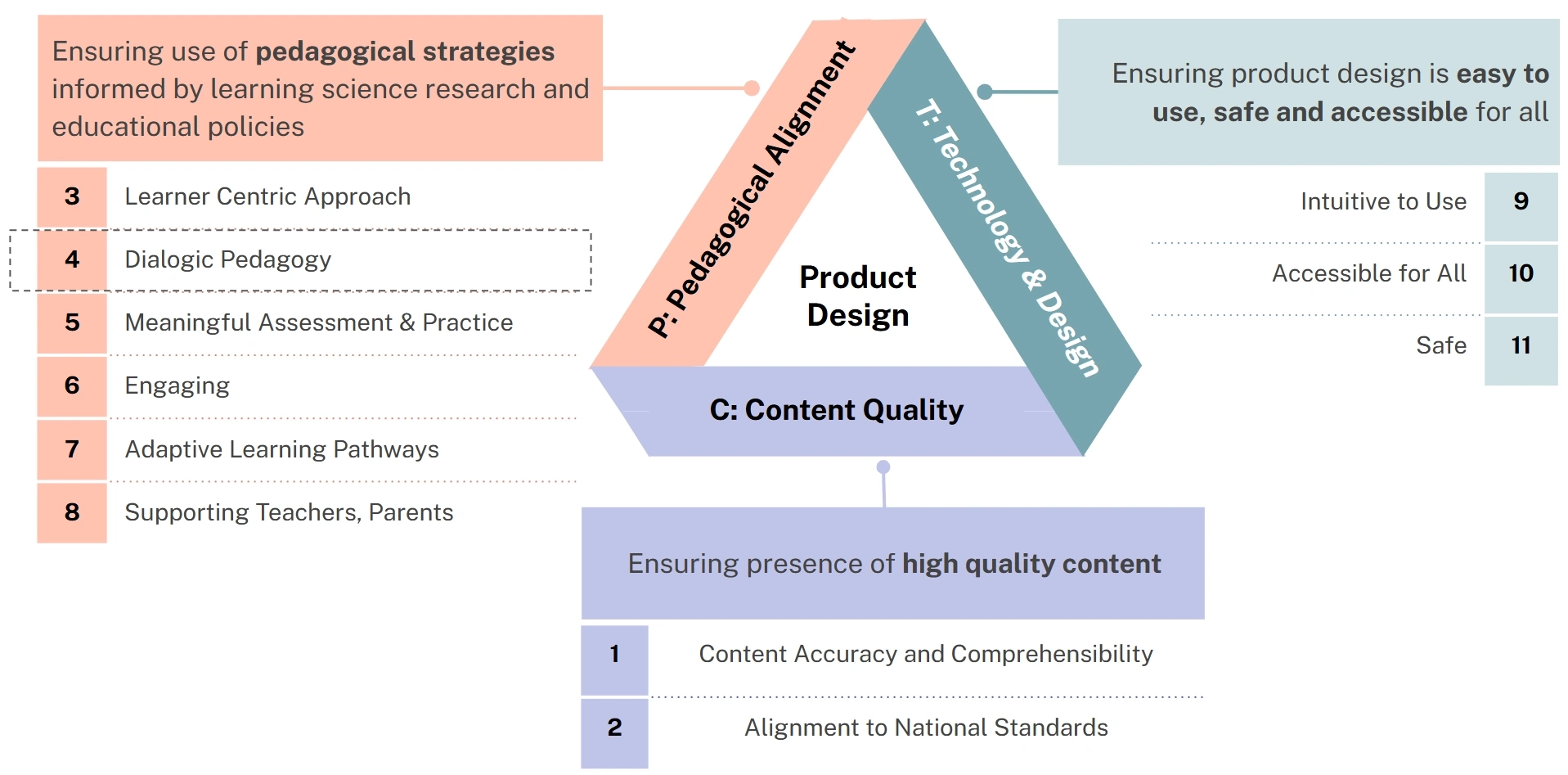
The EdTech Tulna framework was built on three core evaluation dimensions: Content Quality, Digital Pedagogy, and Technology & Design, organised within an established four-level structure of dimension, cluster, criteria, and indicator.
The EdTech Tulna Standards for AI-Powered Solutions retains these three dimensions to evaluate AI-powered digital learning solutions. It extends them with AI-specific evaluation criteria that assess interaction quality, contextual continuity, reliability of generated outputs, transparency of system behaviour, and other characteristics unique to AI-powered learning experiences.
The framework is grounded in six empirically identified AI failure modes and introduces a formal AI role classification to ensure evaluation criteria are applied according to each learning solution's intended use. Through a scenario-driven methodology, evaluators assess how AI systems behave in authentic learning contexts. Throughout, every evaluation remains learner-centric, examining educational quality, safety, learner well-being, and the effectiveness of AI-powered learning solutions across India's diverse linguistic, cultural, and infrastructural contexts.

Standards for AI-Powered Solutions
Overview of the updated standards, with new clusters, criteria, granular indicators, and objective checkpoints.

Tulna Framework - AI Extension: Standards, Objectives, and Evaluation Approach
Systematic, evidence-based approach for AI-powered learning solutions.

At a glance - Standards for AI-powered solutions
Brief two-page overview of Tulna’s approach, solution, impact, and tailored offerings.
Tulna Foundational Framework: Objectives, Evaluation, and Scoring Approach
Systematic, evidence-based approach integrating academic research, policy insights, and stakeholder inputs.
Content Accuracy and Comprehensibility
Correctness and clarity in learning content
Is the learning content factually correct and clear?
Factual Accuracy
Clarity
Correctness and clarity in assessments
Are the practice questions, activities, assessments, and their feedbacks/solutions factually correct and clear?
Factual Accuracy
Clarity
Language comprehensibility
Is the language appropriate for intended learners with age-appropriate vocabulary, easy to follow accent, and good audio quality?
Grade-Appropriate Vocabulary
Simple Text Structure and Clear Handwriting
Easy to Follow Voice
Content Complexity (Specific to English Subject)
Is the learning unit of appropriate complexity for the intended learner?
Complexity in Layout, Ideas and Meaning
Variety in content type (specific to Language education)
Is the variety in teaching learning material appropriate and relevant to the grade range?
Variety in Content Type
AI Content Trustworthiness (in context)
Does the AI-generated content draw exclusively from verified, curriculum-aligned educational sources, while ensuring transparent labelling and disclosure?
Source Traceability
AI Labelling
AI Disclosure
AI Content Trustworthiness (in process)
Does the product disclose how AI-generated content is generated, maintained, and updated?
Data Training & Retrieval Transparency
Human-in-the-Loop Validation Protocols
Alignment to National Standards
Curriculum Alignment
Is the learning content aligned to the target curriculum and recommended skills in national standards like NEP 2020, NCF 2023, with adequate comprehensiveness and depth?
Topic/Curriculum Goal Alignment
Competencies/LO Level Alignment
Inclusive representation
Does the product content avoid traditional stereotypes and include representation of diverse characters, examples, and scenarios?
Avoidance of Stereotypes
Representation of Diversity
Bilingual Use
Does the product include use of English to introduce learners to English technical terms while imparting instructions in the native language?
Technical Terms in English (Voiceover)
Technical Terms in English (in Visuals)
Content and Pedagogy Alignment
Are the pedagogical strategies used in the product aligned with national standards?
Appropriate Pedagogical Strategies